Since the start of the war between the United States and the Islamic Republic, the streets of major cities in Iran have become more crowded with street vendors. Considering the severe economic sanctions and the U.S. naval blockade, which have sharply intensified economic pressure on Iran, this is not an unusual development. Many people have lost their regular jobs or had to vacate the shops they rented for their small businesses. Without better alternatives, they have turned to street vending as a form of survival entrepreneurship.
A trend that was already emerging before the war, however, appears to be becoming more visible. Many new street vendors are young women doing this for the first time.
Street vending in Iran, associated with men and, to a lesser extent, older or middle-aged working-class women. Most empirical studies in Tehran before 2024 reported very few women in street vending.
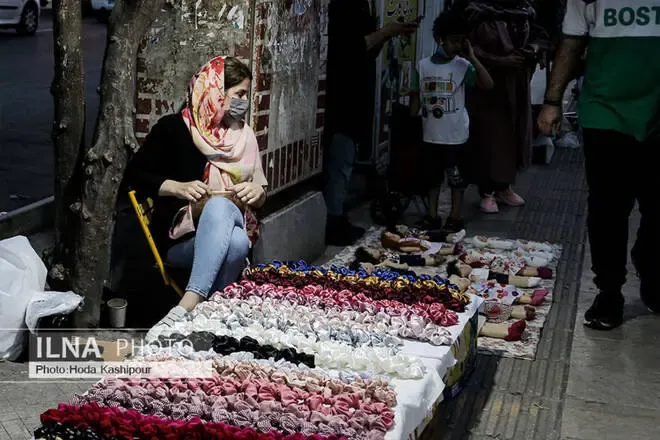
The growing presence of younger women now includes students, university graduates, former professional workers, and women from backgrounds that, until recently, were often associated with Iran’s middle class. Their growing presence in street vending may therefore reflect not only an expansion of informal work, but also the downward economic mobility of parts of the middle class. Some pass the time reading a book while waiting for customers. Many are also savvy in digital commerce, such as maintaining an Instagram sales account, and combine online sales with street vending. Some use their Instagram or Telegram accounts to let potential buyers know where they'll be vending.
They set up a small table or spread a blanket on sidewalks next to other street vendors to display their products. They offer clothing, jewelry, cosmetics, handicrafts, homemade foods, and inexpensive consumer products. Some work in partnership with their husbands or other relatives. In the evening, they simply gather their merchandise into bags or suitcases and leave.
In interviews with various reporters, these young women point to high living and education expenses as their main motivation for turning to street vending. They come from diverse backgrounds, including housewives, young university students, former professional workers, and university graduates with undergraduate or master’s degrees.
Until recently, only a relatively small number of women worked as street vendors, and they tended to come from poor and lower-income families. A 2023 study of public-space vending in one area of Tehran found only one woman among 110 street vendors. Women vendors instead tended to operate in more enclosed environments, particularly women-only metro cars.
The increased presence of female vendors on open sidewalks appears to have accelerated amid the difficult economic conditions of recent years, which have pushed both men and women toward vending because of a lack of better alternatives. The growing presence of women, however, may also indicate the opening of a new business space that, for social or economic reasons, women tended to avoid in the past.
Street Vending as Survival Entrepreneurship
The sharp increase in street vending in recent months reflects Iran’s severe economic crisis. The country has been a target of comprehensive economic and financial sanctions for more than two decades, which have disrupted Iran’s international commerce and oil revenues. These external pressures, together with corruption and economic mismanagement under the Islamic Republic, have contributed to large fiscal deficits and high inflation, pushing millions of people into poverty. Conditions have worsened since mid-2025 with several military exchanges and considerable war damage, followed by more intense sanctions and a naval blockade since April 2026.
Economic hardship is pushing more women into precarious work, but their growing presence in public commercial spaces may also contribute to changing gendered expectations about where and how women can participate in economic life.
Economic pressure on households has intensified as hundreds of thousands of jobs have been lost and many businesses have gone bankrupt. Many households are now struggling to afford necessities such as food and medicine.
The most recent labor market data indicate that the war and sanctions since mid-2025 have had a more negative impact on women’s employment than on men’s. During winter 2026, the number of working women fell by 231,000, while the number of working men rose by 247,000. The differential impact on men and women was also visible in the unemployment data. While the unemployment rate for women rose from 14.2% to 15%, it declined from 6.5% to 6.2% for men.
This period began with the widespread protests of January 2026, which resulted in thousands of casualties among protesters and ordinary citizens, and ended with several weeks of U.S. and Israeli aerial bombardments that caused considerable physical damage and war casualties.
One of the first responses by Islamic Republic authorities was to cut off civilian access to the internet. For many Iranian women who relied on the internet to work and sell products online, this was a particularly adverse development that disrupted their usual sources of income. While internet access has been restored in recent months, it remains unreliable, and renewed conflict could shut it down again.
These developments have pushed many women into street vending because they lost jobs and income opportunities. For many, this may be their first experience with informal business entrepreneurship, a form of survival entrepreneurship born of necessity. They must decide what types of products to sell, find a suitable location, take on financial risk, and compete with hundreds of other vendors, including many women in similar circumstances.
If and when the war and severe economic sanctions end and the Iranian economy recovers, many of these women may return to more stable formal jobs or their previous businesses. For some, however, self-employment, risk-taking, finding customers, and managing a small business may build skills and confidence that could later carry into more conventional forms of entrepreneurship.
Furthermore, their participation in street vending locations in larger numbers may reflect the weakening of another taboo about the appropriate business environment for women. Streets may join women-only metro cars, retail shops, shopping malls, and family restaurants as increasingly accepted business spaces for women.
This development contains an important tension. Economic hardship is pushing more women into precarious work, but their growing presence in public commercial spaces may also contribute to changing gendered expectations about where and how women can participate in economic life.